



Artists
Hidden Hazards In The Art Studio
Here you will find presentations, links, and reading materials related to Barnstable County’s Hidden Hazards in the Art Studio initiative, sponsored by the Barnstable County Hazardous Waste, Water Quality, and Recycling Program.
Many art supplies contain chemicals that can harm people, pets, and the environment.
Hazards may be found in fumes, dust, or liquids.
Choosing safer products and reducing exposure protects your health and your home.
Quick Safety Tips
-
Choose less toxic products when possible
-
Improve ventilation
-
Wear appropriate protective equipment
-
Store chemicals safely
-
Dispose of unwanted supplies at a Household Hazardous Waste collection event
Some art materials may contain toxic or flammable ingredients, including:
-
Oil paints
-
Acrylic paints
-
Watercolors
-
Ceramic glazes
-
Heavy metal pigments such as lead or cadmium
-
Pickling liquids
-
Adhesives and solvents
Some solvents release volatile organic compounds, or VOCs.
Oil-based paints and some adhesives are flammable.
Less toxic alternatives are available for most consumer-grade art supplies.
Consider safer options such as:
-
Water-based paints instead of oil-based paints
-
Pencils instead of permanent markers
-
Pre-mixed clay instead of powdered clay
-
Heptane instead of hexane in adhesives
-
Spike lavender oil instead of turpentine
Less toxic does not mean non-toxic. Always review product information before purchasing.
Check labels before buying new materials.
Common label terms include:
AP Seal
Certified as non-toxic for intended use.
CL Seal
Contains hazardous ingredients. Use with caution.
Health Caution Label
Indicates a product is more toxic than a similar non-toxic version.
California Proposition 65 Warning
Warns of possible cancer, birth defects, or reproductive harm.
Products labeled for professional use may contain higher levels of hazardous ingredients.
Every art product has a Safety Data Sheet available online.
An SDS includes:
-
Health risks
-
First aid information
-
Fire response guidance
-
Safe handling and storage instructions
Review the SDS before using new or unfamiliar materials.
Lowering exposure helps prevent short-term and long-term health effects.
Protect yourself by:
-
Wearing gloves and eye protection
-
Using respirators when needed
-
Improving ventilation
-
Cleaning with wet methods to reduce dust
Limiting exposure before developing chemical sensitivities is important.
Fumes and dust may contain harmful chemicals.
To reduce inhalation risks:
-
Work in well-ventilated areas
-
Use local exhaust ventilation when possible
-
Use wet processes instead of dry
-
Avoid sweeping dry dust
Some art materials can ignite without warning.
Rags soaked in:
-
Linseed oil
-
Lacquer thinner
-
Citrus solvents
can spontaneously combust.
Hang rags to dry before disposal.
Store flammable materials away from heat sources such as kilns or heaters.
Store materials carefully:
-
Keep incompatible materials separate
-
Store acids away from bases and solvents
-
Keep bleach, ammonia, and hydrochloric acid apart
-
Store chemicals upright
-
Keep flammable products away from heat
Relabel containers if transferring materials.
Dispose of unwanted art supplies at a Household Hazardous Waste collection event or facility.
Children, birds, and small animals are more sensitive to chemical exposure.
A small dose for an adult may be harmful to:
-
Children
-
Pets
-
People with compromised immune systems
Keep supplies out of reach.
Prevent contamination of food and water.
Chemicals can enter the body in three ways:
Ingestion
Through contaminated food or water, or pets grooming themselves.
Inhalation
Breathing vapors, fumes, smoke, powders, or dust.
Skin Contact
Absorption through the skin.
Printable Materials
These materials are designed for printing and distribution. All educational content is provided in accessible text on this page.
Brochure
Protect & Dispose Poster
Pet Safety Poster
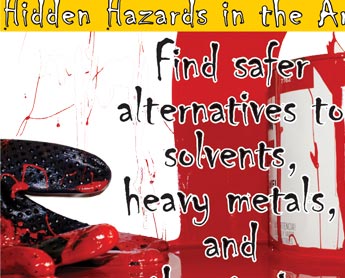
Hidden Hazards Magnet
VIDEOS
Below you will find our Hidden Hazards in the Art Studio series and our training video
LINKS, EDUCATIONAL RESOURCES & NEWS
- Mccann, Michael. (2005). Artist Beware, Updated and Revised: The Hazards in Working with All Art and Craft Materials and the Precautions Every Artist and Craftsperson Should Take . Lyons Press. New York.
- Rossol, Monona. (2001). The Artist’s Complete Health and Safety Guide. 3 rd Ed. Allworth Press. New York.
- Shaw, Susan and Monona Rossol. (1991). Overexposure: Health Hazards in Photography. 2 nd Ed. Allworth Press. New York.
- The Art & Creative Materials Institute, Inc. (1994). What You Need to Know About the Safety of Art & Craft Materials. Boston. (A 12 page booklet on the approval seals of the ACMI voluntarily used by members of this non-profit trade association of manufacturers of art, craft and creative materials. Includes basic safety tips and toxicology information connected with art materials. Free from: The Art & Creative Materials Institute, Inc., 1280 Main St. P.O. Box 479, Hanson, MA 02341. Tel: (781)-293-4100.
 Send an Email
 508-375-6699