
Interesting Facts
Interesting Facts
Barnstable is a name that can cause a bit of confusion sometimes (pronounced barn-stuh-bul). That is because it refers to the County, which encompasses the region known as Cape Cod, and it also refers to the Town of Barnstable, one of the 15 towns on Cape Cod, and finally, it refers to the villages within the town of Barnstable, Barnstable Village and West Barnstable.
Cape Cod has 4 regions:
- Upper Cape (Bourne, Sandwich, Mashpee, Falmouth)
- Mid Cape (Barnstable, Dennis, Yarmouth)
- Lower Cape (Brewster, Harwich, Orleans, Chatham)
- Outer Cape (Eastham, Wellfleet, Truro, Provincetown)
Mercy Otis Warren (1728–1814), poet, essayist, historian, and America’s earliest-known female playwright, produced satirical political commentary which influenced public opinion, rallied opposition to British oppression, and celebrated rebel victories. Mercy Otis was born in Barnstable, Massachusetts on September 14, 1728, eldest daughter of Mary Allyne Otis and James Otis Sr., who was farmer, merchant, attorney, and later a member of the Massachusetts House of Representatives. Although Warren had no formal education, her father permitted her to study with the Reverend Jonathan Russell while he tutored her brothers. [1]
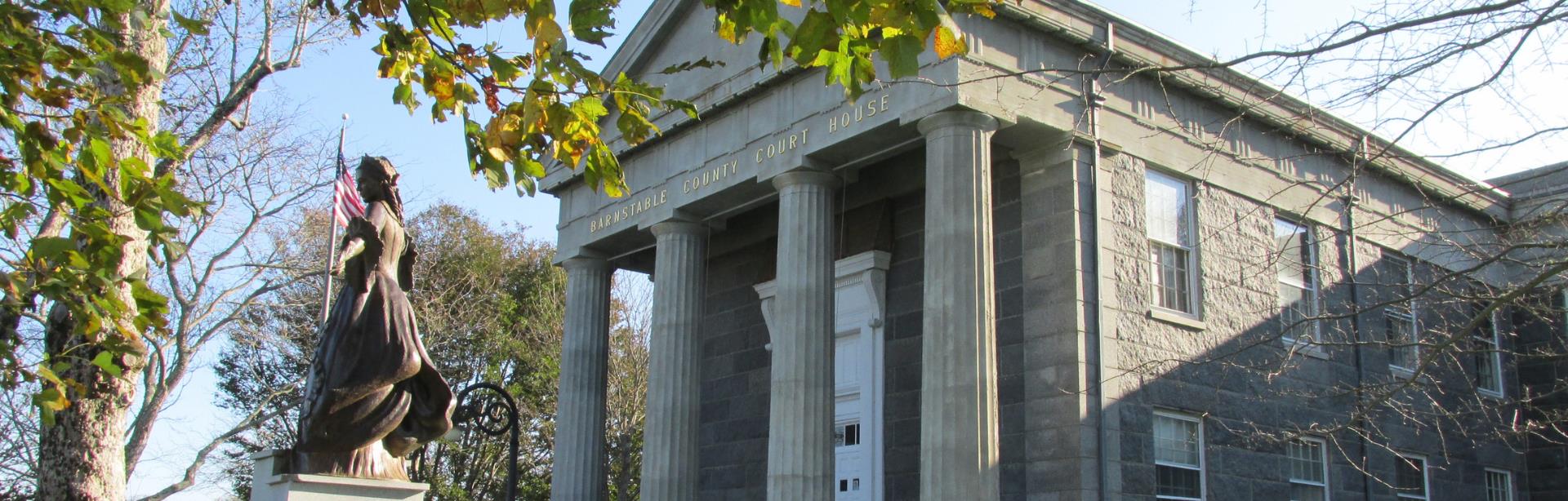
Two seven-foot bronze statues by Cape Cod sculptor David Lewis memorialize Mercy Otis Warren and her brother James Otis, Jr. outside the Barnstable County Courthouse.
Read an informative Cape Cod Life article for more history.
[1] Maud Macdonald Hutcheson, “Mercy Warren, 1728-1814,” The William and Mary Quarterly, Third Series, 10, No. 3 (Jul., 1953), 383.
June 2
Barnstable County was formed as part of the Plymouth Colony on June 2, 1685, including the towns of Falmouth, Sandwich and others lying to the east and north on Cape Cod. Plymouth Colony was merged into the Province of Massachusetts Bay in 1691. Learn more…
September 27
Barnstable County Independence Day is recognized on September 27 and was first commemorated on September 27, 2018.
Tales of Cape Cod, Inc., a non-profit organization dedicated to preserving and disseminating Cape Cod’s history, initially proposed recognition of Barnstable County Independence Day.
It is estimated that as many as 1,500 ordinary citizens from across Cape Cod gathered in front of Barnstable’s Olde Colonial Courthouse on September 27, 1774 – nearly two years earlier than when America declared independence from Great Britain – to protest the Intolerable Acts decreed by the British to punish Colonists for the Boston Tea Party. Until then, the Province of Massachusetts enjoyed nearly complete local autonomy under its 1691 royal charter. The Intolerable Acts changed this by taking away the colonists’ rights to elect their government officials, choose jurors locally, and hold town meetings.
Counties across Massachusetts moved to shut down their courthouses before the new Crown-controlled courts could sit for the fall session in 1774. In Barnstable County, protesters demanded that the County desist from all government business until “the mind of the continental, or a provincial, Congress shall be obtained” and ended with County officials signing a document that conceded to the cancellation of the court’s fall session.
By the end of that week in September, Cape Cod was in every respect rid of British control, and by the end of that year, British control had ended in all of Massachusetts except Boston. In response, the next April, British dispatched troops to Concord to secure munitions stored there — and with the Battle of Lexington and Concord, the Revolutionary War began.