
History
Barnstable County — Now
In April 2025, we celebrated National County Government Month with the theme: Barnstable County: Then & Now.
Throughout the month, we highlighted how Barnstable County has evolved over the centuries—from its historic role in the Revolutionary War to the modern-day services that support our communities.
We continue to share these stories, including a special video series featuring Mary LeClair, former County Commissioner (1996–2008) and local history enthusiast. In the first video, she offers fascinating insights into the County’s rich past. You might be surprised to learn about Barnstable County’s role in key moments of early American history—from Revolutionary War connections to pioneering wildfire control with our first airplane in 1954.
Watch the first video in the series below.
Barnstable County — Then
Cape Cod—a narrow, sandy peninsula in southeastern Massachusetts, bounded by Nantucket Sound, Cape Cod Bay, and the Atlantic Ocean—is home to more than 220,000 year-round residents. Its history has been shaped by the waters surrounding it and by the people who have called it home for thousands of years.
Long before the arrival of European settlers, the Wampanoag people, also known as the People of the First Light, lived throughout the region now known as Massachusetts and eastern Rhode Island. This Algonquian-speaking nation has lived here for more than 12,000 years and was part of a rich network of Indigenous nations and communities—many of which continue to thrive today. The Wampanoag people maintain a strong cultural and community presence on Cape Cod to this day.
In 1620, a group of European settlers known as the Pilgrims departed from Plymouth, England, aboard a rented cargo ship called the Mayflower. After a three-month voyage, they first sighted land at the tip of Cape Cod in what is now Provincetown. While anchored there, the adult men aboard signed the Mayflower Compact on November 11, 1620—an agreement establishing a framework for self-government in the New World.
Though they eventually settled in Plymouth, the Pilgrims’ first contact with American soil was here on Cape Cod. On December 21, 1620, an exploratory party landed in the area that would become Plymouth Colony. The territory of the Colony extended from Cape Cod Bay on the east to Narragansett Bay on the west and included parts of present-day Massachusetts and Rhode Island.
The arrival of European settlers marked a significant turning point for the Indigenous peoples of the region—introducing profound and lasting changes to their land, lives, and sovereignty.
Over time, the colonies expanded, and the governance of these growing settlements required more structure. To meet this need, Plymouth Colony created administrative divisions.
Barnstable County was officially established on June 2, 1685, alongside Plymouth and Bristol counties.
At that time, Barnstable County included the following towns:
Sandwich (founded 1639)
Yarmouth (1639)
Eastham (1646)
Barnstable (1650)
After considerable debate, the Town of Barnstable was chosen as the “shire town” or county seat, due to its central location. Barnstable Village became the administrative hub, a designation it still holds today.
Running through Barnstable Village is Route 6A, once known as the Old King’s Highway—one of the oldest traveled roads in the United States.
In its early years, Barnstable County served a judicial role. Over time, its responsibilities expanded to include operating jails, maintaining health facilities, overseeing roads and agricultural land, and managing land and deed records. County government functioned as an administrative arm of the Commonwealth, with officials such as commissioners, treasurers, sheriffs, clerks of court, and registers of deeds elected in accordance with state law.
Barnstable County Through the Years: A Timeline Since 1685
Explore the key moments that have shaped Barnstable County since its founding in 1685—from colonial roots to regional leadership today.
Barnstable County is Established
Plymouth Colony forms Barnstable County to bring courts and records closer to Cape Cod towns.
Mashpee Wampanoag Land Deed Confirmed
Plymouth Colony recognizes a 25-square mile deed reserved by the Tribe in 1665
- an early act of Wampanoag sovereignty amid colonization.
Old Jail Constructed in Barnstable
The original county jail
- Now the oldest wooden jail in the U.S.
- Served until the 1820s.
Plymouth Colony is absorbed into the Province of Massachusetts Bay
Barnstable County continues under the new royal government.
Citizens shut down British courts in Barnstable
Cape residents block the courthouse, ending royal authority months before the Revolution begins.
Massachusetts Constitution adopted
Barnstable County continues operating under the new Commonwealth framework, managing courts, jails, & land records.
Second Barnstable jail constructed
A new jail replaces the original wooden structure, used into the early 20th century.
Fire destroys early land records at Registry of Deeds
Many original 17th- and early 18th-century documents are lost in a fire at the county courthouse.
The Massachusetts Legislature abolished the Court of Sessions and the Commissioners of the Highways
Replacing them with an appointed Board of County Commissioners.
Barnstable Superior Courthouse is constructed
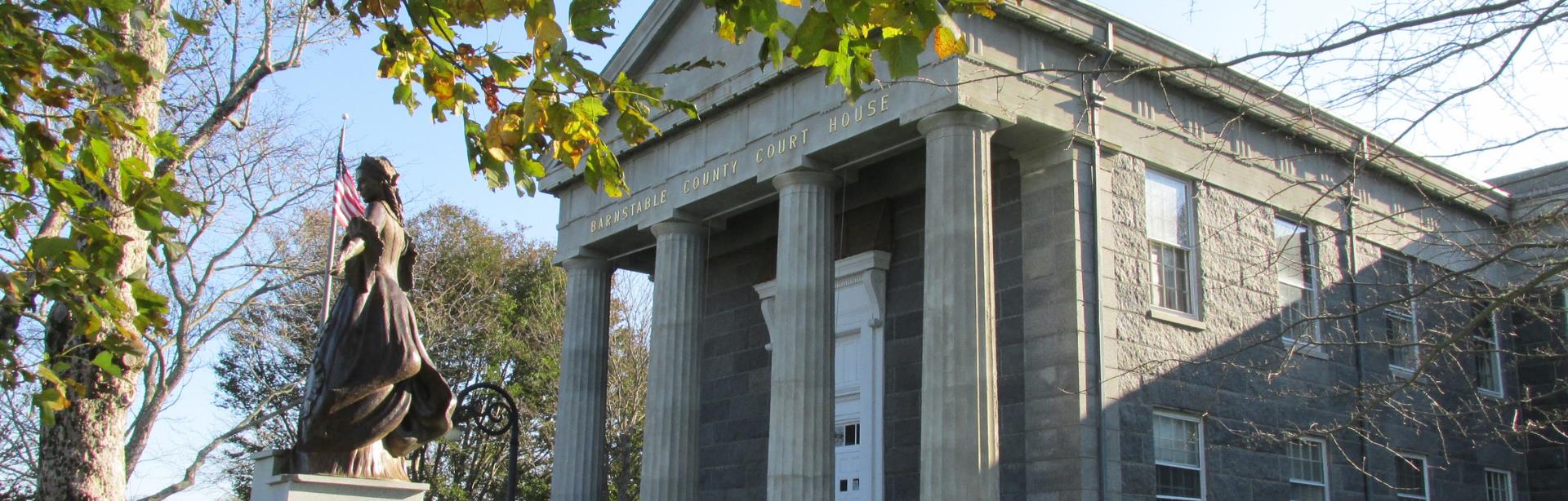
Designed by renowned architect Alexander Parris, who also designed Boston’s Quincy Market, the Greek Revival granite courthouse remains in use today & is one of the oldest continuously operating courthouses in the United States.
Cape Cod Cooperative Extension founded
Launches community education programs in agriculture, youth development (4-H), nutrition, marine science, and sustainability.
Cape Cod Canal opens
Redefines Cape Cod’s geography and economy; increases need for regional coordination, infrastructure, and emergency planning.
Barnstable County Hospital opens in Bourne
Established as a tuberculosis sanatorium, the hospital evolves to serve various public health needs over the decades before closing in 1995.
Department of Health & Environment created
One of the first regional public health departments in the state, supporting water safety, sanitation, and disease prevention.
Barnstable County Jail and House of Correction constructed
Located in Barnstable Village, this facility becomes the operational base of the Sheriff’s Office, which is part of county government at the time.
Sagamore and Bourne Bridges completed
Major access points to Cape Cod, increasing mobility & regional service needs.
Addition built onto the 1935 County Jail
Constructed to ease overcrowding and improve inmate housing conditions.
Court operations transferred to the state
As part of a judicial reorganization in Massachusetts, Barnstable County no longer oversees court administration. The state assumes full responsibility for operating the courts, while the county continues to maintain the courthouse facilities.
Home rule charter approved
Transforms Barnstable County into a modern regional government with a legislative Assembly of Delegates and an executive Board of Regional Commissioners – one of the few counties in Massachusetts to survive state reforms in the 1980s and ’90s.
Cape Cod Commission created
A regional planning and regulatory agency guiding land use, water protection, and smart growth across the Cape.
County Dredge Program Launched
Offers cost-effective dredging services for towns, improving navigation & flood mitigation.
Children’s Cove Opens
A trauma-informed child advocacy center serving victims of abuse across Cape Cod, Martha’s Vineyard, and Nantucket.
Americorps Cape Cod founded
A public service program focused on environmental stewardship, disaster response, and community service across the region.
MASSTC opens in Sandwich
The Massachusetts Alternative Septic System Test Center is launched by George Heufelder, who began as an Environmental Specialist and later served as Director of the Department of Health and Environment from 2002 to 2016.
County water quality lab expands
Provides analytics support for beach safety, drinking water testign, & environmental protection for all 15 towns.
Barnstable County Correctional Facility opens in Bourne
A modern facility near Joint Base Cape Cod replaces the outdated jail in Barnstable Village.
Barnstable County Sheriff’s Office relocates to new correctional facility
The Sheriff, historically part of county government, transitions operations to the new locations.
Old County Jail repurposed for county offices
The former jail becomes office space for regional programs, including the Department of Health & Environment.
Sheriff Becomes a State Office
Following statewide restructuring, all sheriffs in Massachusetts become state employees. The Barnstable County Sheriff’s Office is no longer part of county government.
County leads COVID-19 response
Coordinates vaccinations, testing, PPE distribution, and regional public health planning in collaboration with all towns.
County leads efforts in coastal resilience and wastewater reform
With climate change and population pressures mounting, Barnstable County plays a central role in preserving Cape Cod’s future.
Barnstable County supports 15 towns through shared services
Providing leadership in public health, emergency planning, environmental protection, regional governance, and civic engagement.
Mashpee Wampanoag Tribe remains a sovereign nation
One of only three surviving tribes from the original Wampanoag Nation, the Mashpee Wamanoag continue to live, lead, and protect their heritage within Barnstable County.