


Barnstable County Presents PFAS Groundwater Modeling and Forensics Update at UMass Amherst
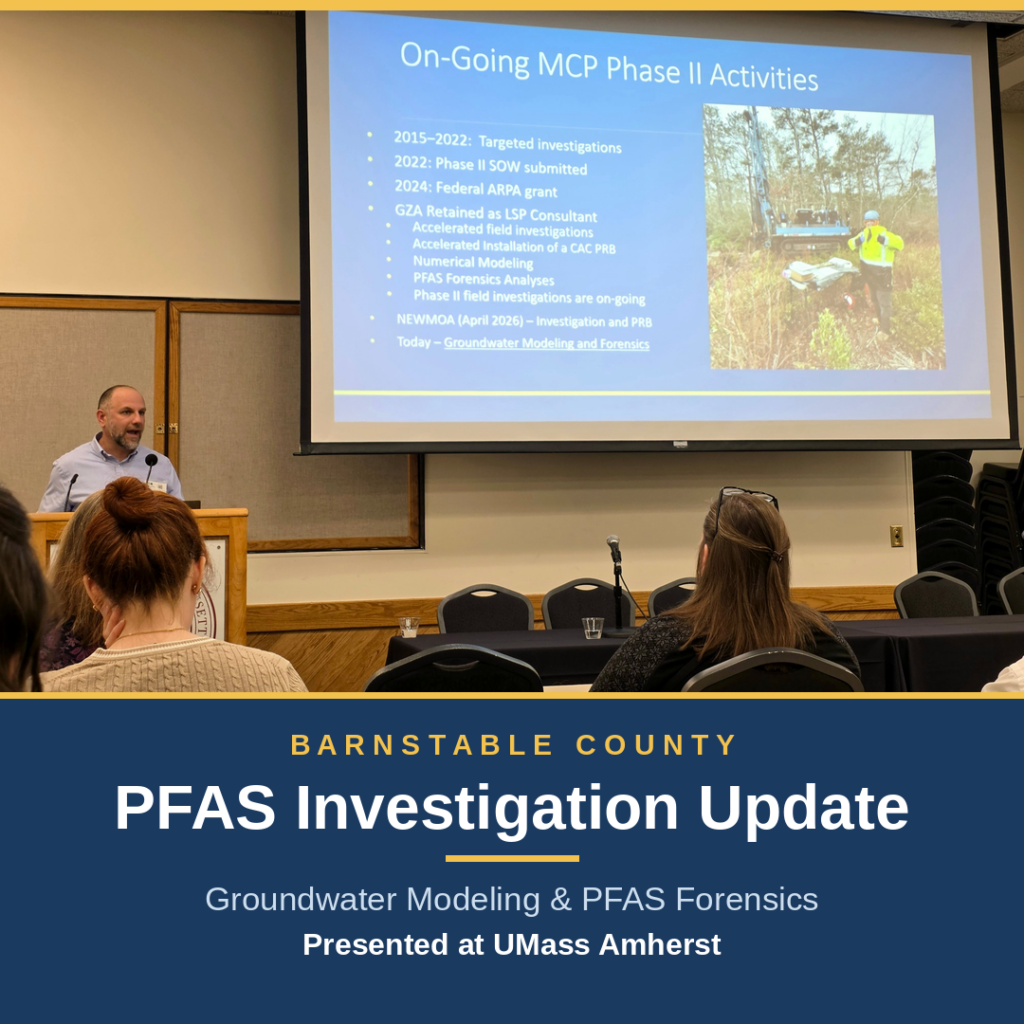
Barnstable County presented this week at UMass Amherst on the ongoing PFAS investigation at the former Municipal Fire Training Facility in Hyannis.
Paul Ruszala, P.E., the County’s Assets & Infrastructure Manager, presented with Matt Gozdor, P.G., and Jeremiah Duncan, Ph.D., of GZA GeoEnvironmental, Inc., the County’s Licensed Site Professional (LSP) consultant for the site. Their presentation, PFAS Investigation at the Former Barnstable Massachusetts Municipal Fire Training Facility: Groundwater Modeling and PFAS Forensics, covered the site history, the regional groundwater picture, and the work now underway.
The Site and Its History
The facility at 155 South Flint Rock Road was used for essential fire training from 1959 to 2019 by Cape Cod fire districts and departments from across Massachusetts. Training during that period included legacy firefighting foams (AFFF) containing PFAS. PFAS was first detected in the Mary Dunn supply wells in 2013.
Ongoing Phase II Investigation
The team outlined the ongoing Massachusetts Contingency Plan (MCP) Phase II work: targeted investigations from 2015 to 2022, a Phase II scope of work submitted in 2022, and, following a federal ARPA grant in 2024, GZA’s accelerated field investigations, the accelerated installation of a colloidal activated carbon permeable reactive barrier, numerical groundwater modeling, and PFAS forensics analyses. Phase II field investigations are ongoing.
The groundwater modeling and forensics work is helping the County and GZA understand how groundwater moves over time — including the influence of pumping at the Mary Dunn wells — and distinguish the fire training facility plume from other plumes in the area, including the airport plumes shown in the regional results.
Phase II field investigations are continuing at the site. As the groundwater modeling and PFAS forensics work is completed, the results will help guide the next steps in the Massachusetts Contingency Plan process.
Barnstable County remains committed to seeing this investigation through, protecting the region’s public drinking water supplies, and sharing what the science shows as the work continues.