

System Shift Series: MASSTC Co-Founder George Heufelder on I/A Systems Past & Present

MASSTC Co-Founders George Heufelder and Tony Milham, on site in 1999 and at a recent ribbon cutting at MASSTC in September, 2025
System Shift is a new story series focusing on Cape and Islands homeowners who have I/A systems and/or are practicing alternative ways of dealing with human waste. The series also puts a spotlight on pioneers in the world of advanced treatment. What’s it like to have an I/A system? How does it help the local mission to be better land and water stewards? We’ll tackle these questions and more in hopes of helping “shift” the way we see all the moving pieces of Cape Cod’s wastewater puzzle.
By Amy DuFault, MASSTC Communications
Massachusetts Alternative Septic System Test Center (MASSTC) co-founder George Heufelder and I are having a conversation on a 3-acre test facility on Joint Base Cape Cod that he co-founded 25 years ago with Joe Costa, Dave Janek and Tony Milham. MASSTC, housed at the new Clean Water Center, is home to over 25 I/A technologies being tested by companies dotting the U.S. and beyond. George says in 1999, groups on the Cape were trying to figure out what to do with nitrogen and there was increasingly, a new buzz term by many environmental groups: innovative/alternative septic systems (I/A systems).
At that time Peatmoss I/A systems were in the spotlight, an Innovative/Alternative septic system that uses peat moss, to provide enhanced treatment for wastewater. Known for removing contaminants like nitrogen and bacteria, the Peatmoss are used in areas where traditional septic systems are insufficient. Co-founder Joe Costa, who was with the Buzzards Bay Project at that time, wanted a space to test them.

“It all started at a Big Boy Pancake House,” he says, grinning. “Right there at the Bourne rotary. Dave Janek, and I sitting at a table with our coffee, sketching on napkins. We were trying to figure out how to deal with this nitrogen problem everyone was suddenly talking about.”
That was more than twenty-five years ago—before IA systems, became a buzzword in Cape Cod’s long struggle with its own wastewater. Back then, nitrogen pollution was a problem that scientists were only beginning to connect to the slow suffocation of the Cape’s estuaries and bays.
“Certain folks were saying, ‘We should put I/A systems everywhere, that’ll fix it,’” he remembers. “But I looked for data—any good data on how these denitrification systems actually worked—and I couldn’t find any”, says George.
What began as frustration became the seed of something new: MASSTC. Today, it’s one of the only facilities of its kind in the U.S.—part laboratory, part proving ground, part education center.
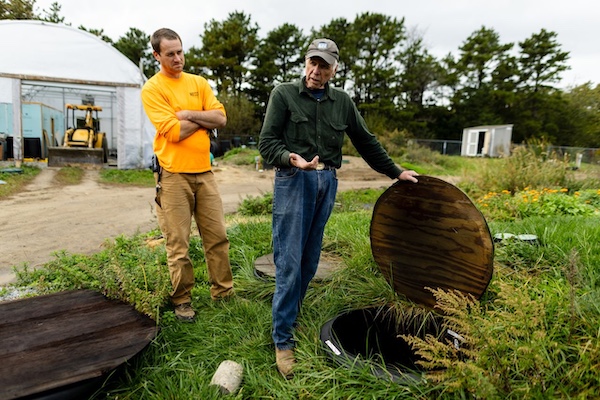
MASSTC Director Brian Baumgaertel and Co-Founder George Heufelder
A Field of Experiments
At the time, no one on Cape Cod wanted a test center in their town. “That’s a huge investment,” he explains. “You’ve gotta have people married to the place. You need engineers, people who can run the systems, figure out what makes them work, what doesn’t,” says George.
The idea of building a dedicated research site for wastewater technology came together slowly. First came the EPA’s Environmental Technology Initiative (ETI) grant. Then came local resistance. The local treatment plants were very hesitant to host a test center for fear of how it would impact their respective discharge permits.
Finally, someone suggested the decommissioned wastewater treatment site at the old Otis Air Base—flat land, stable flow, and, as he puts it, “you can’t get more Cape Cod than being on Cape Cod.”
“So, we said, why don’t we put it there? We’ll test up to six systems—triplicate of each, plus a standard Title 5 septic as a control. That way nobody could give us a ringer and we would have a reference control.”
The goal was simple: collect real data, in real Cape Cod conditions. Winter cold. Sandy soils.
“All the data we had back then came from down South,” he says. “Well, it gets cold up here. All this stuff is biologically mediated. We needed to see how it worked here.”

Tony Milham at MASSTC, 1998
Science Meets Grit
When the center opened, it was hardly glamorous. “Tony and I just babysat the place until it got built,” he recalls. “It was one shed, a few tanks, and a field. That’s it.”
The first technologies tested—BioMicrobics, FAST, Amphidrome, a Canadian Company Waterloo Biofilter and others—came with a requirement: each company had to show a five-year business plan and financial viability. “We didn’t want fly-by-night systems,” he says. “You put these things in people’s backyards, they fail, and then what do you do?”
Over time, the work grew. New technologies arrived, some failed quickly and others proved themselves and stayed. The site became a hub not just for performance testing but for research and development. Vendors began using it as a kind of open-air laboratory to fine-tune designs before seeking state or federal approval.
By the early 2000s, the EPA’s ETI program had evolved into a national Environmental Technology Verification (ETV) system, and the Cape site ran the first five ETV tests in the country. “We loved it,” he says. “It was a good, solid protocol. A year long—not too intense, but thorough.”
Even the infrastructure grew from improvisation. When the state needed viral testing, the staff built a lab themselves. “DEP said, we’ll give you $300,000 for a turnkey lab. They gave us a lot less,” he says. “So Brian (Baumgaertel, Director of MASSTC), put in the sweat equity. We built it inside that building over there,” he says pointing out the window.

MASSTC, 1999
From Septic Myths to Nitrogen Math
George started his career in fisheries biology, not wastewater. But in the 1980s, when state officials began shutting down shellfish beds for bacterial contamination, he started asking questions. “They said, it’s septic systems,” he recalls. “I said, how do you know that? Turns out, it wasn’t—at least not for bacteria. It was stormwater. But the septic systems were bleeding nutrients.”
That finding set him on a decades-long pursuit to understand how wastewater systems leak nitrogen into Cape Cod’s fragile groundwater and embayments.
“Back then, nobody was thinking about nitrogen,” he says. “We just shot it into the ground. You had a septic tank so it wouldn’t clog the soil, and that was that.”
Now, the conversation has shifted—but perhaps not fast enough. “For years, the state said 19 milligrams per liter was the target,” he says, shaking his head. “If 19 is the target, why would anyone build something better? They didn’t. There was no incentive.”

The new reality, he says, is that coastal water quality demands systems that can remove 80% or more of nitrogen—achieving less than 10 milligrams per liter. “Nineteen doesn’t cut it anymore,” he says flatly. “Maybe for drinking water. Not for marine waters.”
The future, he believes, will depend on smarter monitoring, remote sensing, and cheaper maintenance. “The technology will get better,” he says. “The challenge is the mindset. People are used to flushing and forgetting. But that era’s over.”
A Problem of Sludge and Scale
Even with new systems, another challenge looms: what to do with the sludge. Every day, thousands of gallons are trucked off-Cape for treatment or disposal.
“Falmouth alone ships eight thousand gallons plus a day—double that in summer,” he says. “Companies are getting out of the business because it’s too expensive. So, what happens when nobody wants to haul it anymore? I don’t know,” he says, adding that at least one large company on the Cape has already left septic hauling.
He shakes his head. “Somebody will come in, because there’ll be an offer they can’t refuse. But it’ll cost. You’ll pay for it every time you flush.”
Grease, too, has become a quiet crisis. “Treatment plants can’t handle it. Restaurants generate tons of it. Right now, most of it is trucked off Cape,” he says. “The more expensive it gets, the more incentive there is to throw it down the drain. That’s the reality.”
When he talks about Cape Cod’s long resistance to wastewater infrastructure, there’s exasperation in his voice.
“In the seventies and eighties, the EPA would’ve paid ninety percent of the cost for a sewer system,” he says. “Ninety percent! And towns still said no. They didn’t want to deal with it. They kicked it down the road. Now we’re paying for decades of neglect.”

George Heufelder in the same trailer MASSTC started out in 25 years ago
Looking Ahead
Today, retired but still deeply involved (“I retired nine years ago, but I’m here every day,” he admits), he looks to the next phase: the Clean Water Center and emerging research on urine diversion—a simple idea that could keep much of the nitrogen out of wastewater in the first place.
“I get excited about recycling nutrients rather than just putting them down the drain,” he says. “It’s low-tech, cheap, and it works. The hard part is perception—getting people to accept it.”
He knows it will take time. “It’s like taking a candle to an iceberg,” he says. “But it’s starting to melt.”
When asked what keeps him hopeful after all these years, he looks out the window toward the tanks where new systems hum quietly, treating the unseen flow beneath the surface.
“I’m excited about where this place will be in five years,” he says. “We’ve got a lot of growing to do. I don’t have as many birthdays left as I’d like, but I’ll see some of it.”
He smiles again, half-serious, half in jest. “Now how do you frame that into a positive message?”
(Vintage MASSTC images: Tony Milham + Paige Green Photography)
Read more from the System Shift series here.