

System Shift Series: Centerville Homeowners Become Wastewater Ambassadors
System Shift is a new story series focusing on Cape and Islands homeowners who have I/A systems and/or are practicing alternative ways of dealing with human waste. The series also puts a spotlight on pioneers in the world of advanced treatment. What’s it like to have an I/A system? How does it help the local mission to be better land and water stewards? We’ll tackle these questions and more in hopes of helping “shift” the way we see all the moving pieces of Cape Cod’s wastewater puzzle.
By Amy DuFault, MASSTC Communications
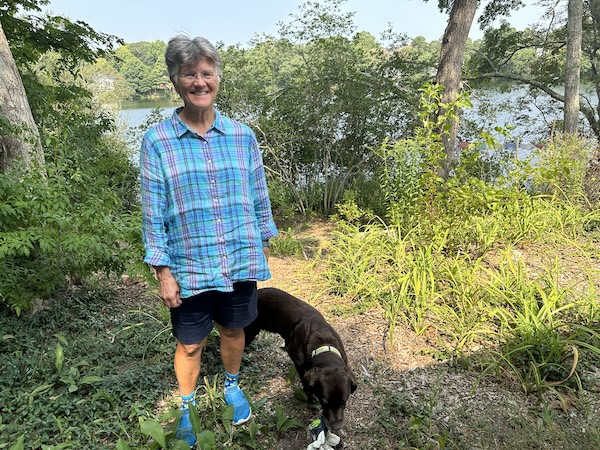
CENTERVILLE — Jane Ward and Steve Waller did not expect that replacing their septic system would make them minor celebrities in the world of wastewater management. But on Cape Cod, where the future of ponds, bays, and drinking water hinges on what happens underground, innovation has a way of drawing a crowd.
“The number and variety of people we are educating about I/A systems has blown our minds,” Jane Ward says, referring to innovative and alternative septic technology designed to remove nitrogen and phosphorus. “Who would’ve thought we’d become ambassadors for advanced wastewater treatment?”
The Ward-Waller’s home, a three-bedroom Nickerson-style house built in 1976 on the south shore of Long Pond, Centerville, sits at the intersection of several environmental features that define the Cape: a sole-source aquifer, nutrient-impaired waterways, and a historic herring run bordering the property. It is precisely the kind of site that regulators, scientists, and planners worry about and precisely why it became a testing ground for what cleaner wastewater might look like.

Their system, a FujiClean CRX, was installed as part of a Massachusetts Alternative Septic System Test Center (MASSTC) pilot testing both Nitrogen and Phosphorus removing technology, partially funded by an Environmental Protection Agency grant. The aim was straightforward: reduce the nitrogen and phosphorus that conventional septic systems send into groundwater, where they eventually supercharge algae blooms, degrade ponds, and threaten public health.
The project’s unadvertised benefit was community. Engineers from Tokyo, installers, regulators, consultants, and clean-water advocates became regular visitors, drawn together by the unglamorous but consequential work of groundwater protection.

For Jane and Steve, the motivation has always been deeply personal.
“This is about a moral imperative,” she said. “One Health, human health, environmental health, economic health…they’re inseparable. If we don’t protect our water, we undermine public health, even risking national security, and we degrade the future for our children and grandchildren. Ultimately, we pay more by doing less.”
That ethic shaped the property well before the septic system went in. The Ward-Wallers removed invasive vegetation and undertook landscape remediation. In the winter of 2020–21, the environmental planning firm Horsley Witten designed a pervious driveway installed by Outerland of Mashpee. The replanting plan was designed to better manage stormwater — early signals that water, in all its forms, would be treated carefully here.
“Wherever we’ve lived, we’ve always made it a point to improve our home, making many of the 17 homes we lived in during our U.S. Air Force years, more sustainable and greener,” said Steve and Jane.

When the FujiClean CRX innovative/alternative septic system became available through the MASSTC program, it aligned neatly with that philosophy. But first came the data. Baseline testing of the existing Title 5 system, conducted in early 2022, revealed nitrogen concentrations near 200 milligrams per liter and phosphorus between 30 and 35 milligrams — levels that startled even seasoned observers. In fact, the MASSTC team repeated their testing to be sure it wasn’t a lab error.
“We were astounded,” Steve said.
At the same time, household water use was strikingly low. From January through June 2022, Jane and Steve used just 7,000 gallons total, about 38 gallons per day, creating an unusually clean and precise data set for researchers. Jane and Steve had lived in California and Texas during multi-year droughts, while in the USAF, training them to conserve water as a habit.
Installation of the FujiClean CRX took place in July 2022. While the core system functioned as designed, the advanced treatment component was delayed by electrical issues and the challenge of adapting Japanese engineering standards and instructions written in Japanese to American infrastructure. By October, the Ward-Wallers marked the occasion with a small open house that was part ribbon-cutting celebration, part teach-in for neighbors and clean-water advocates curious about what next-generation septic technology might offer. Over a dozen neighbors and friends from many towns away came to see the system (on a cold, rainy day!) and Sara Wigginton of MASSTC was kind enough to come answer any technical questions.

Three and a half years later, the pilot phase is complete, and the results are striking. Total nitrogen levels often fall below 10 milligrams per liter. Total phosphorus is frequently undetectable. By any standard, the system dramatically outperforms a conventional Title 5 installation.
“We’ve learned a lot about the design and often quirky behavior of wastewater treatment dependent on how well the bacteria in the system can digest the input in varying temperature, nutrient content, etc. It is an art and a science,” says Jane.
The path to those results, however, was far from simple. Navigating Department of Environmental Protection oversight and dense regulatory requirements required ongoing support from Horsley Witten, not just for engineering but for administration. Even with grant funding covering roughly half the cost, the Ward-Wallers paid about $25,000 out of pocket. With no formal responsible management entity in place, they effectively served as their own contractors. Updates from oversight agencies were slow and often opaque.
This was not, Ward emphasized, a “set it and forget it” solution.

The system works exceptionally well, she said, but it asks something of its operators: curiosity, diligence, patience with bureaucracy, and a willingness to engage deeply with systems most homeowners would prefer to keep out of sight.
“One ‘hiccup’ occurred when a minor power outage turned off the electric components, including the alarm to tell us that the power was off,” says Jane.
“We didn’t realize the shutdown had happened for a few weeks- so the system needed a boost to get going after the power was restored,” Steve adds and that the design flaw was shared with the company engineers.
“In the end, we are thrilled to have been invited to participate in the pilot study of phosphorous-removing I/A septics. This experience has opened up a new world of important challenges, friendships with dedicated professionals and residents alike.”
And yet, on the Cape, a place increasingly defined by water-quality debates, ecological limits, and the economic consequences of inaction, the stewardship demonstrated by Jane and Steve offers a glimpse of a healthier future. Wastewater, it turns out, is not just something to manage, it’s something to slowly understand.