
System Shift Series: Shubael Pond Homeowners Tackle Nitrogen Pollution with Innovative Septic Systems
System Shift is a new story series focusing on Cape and Islands homeowners who have I/A systems and/or are practicing alternative ways of dealing with human waste. The series also puts a spotlight on pioneers in the world of advanced treatment. What’s it like to have an I/A system? How does it help the local mission to be better land and water stewards? We’ll tackle these questions and more in hopes of helping “shift” the way we see all the moving pieces of Cape Cod’s wastewater puzzle.
By Amy DuFault, MASSTC Communications
In the tranquil neighborhood of Sand Shores, nestled along the 57-acre Shubael Pond in Marstons Mills, something remarkable is happening—quietly, and mostly underground.
Shubael Pond, located in the Three Bays watershed in Massachusetts, is one of many freshwater ponds in the Cape Cod region experiencing an increase in toxic cyanobacterial blooms leading to pond closures during summer months. These toxic blooms, are fueled by nutrients like nitrogen and phosphorus entering the groundwater and then surface waters, like ponds. The main controllable source of these nutrients in Cape Cod is wastewater from septic systems.

Though this project isn’t fixing the blooms in Shubael Pond, it is working to implement nutrient management solutions in the Three Bays watershed about a mile down the road. The Massachusetts Alternative Septic System Test Center, a division of the Barnstable County Department of Health and Environment, joined a partnership with the Barnstable Clean Water Coalition (BCWC), the U. S. Environmental Protection Agency, and other stakeholders to take on this challenge.
This project replaced standard Title 5 septic systems with innovative/alternative (I/A) systems designed to reduce nitrogen inputs from wastewater. These upgrades began with a demonstration project including 14 homes in a neighborhood abutting Shubael Pond. The neighborhood could become a model for other neighborhoods across Cape Cod.
Read more on The Shubael Pond Project here.
The project’s unlikely origin? A conversation at church.

Pat Uhlman, a longtime Sand Shores resident and board member of the neighborhood association, struck up a chat with a woman from BCWC after a service. When the woman learned Pat lived on Shubael Pond, Pat remembers, “She pounced.”
“They were looking for neighborhoods near polluted water bodies to partner with for an I/A septic system project,” Pat said. She invited BCWC’s Zee Crocker to speak with six board members, and soon after, Zee addressed the full membership at an annual meeting. The idea caught on.
A community meeting drew 30 to 40 residents interested in learning how the new septic systems could help protect their watershed—and if their homes might be eligible. Zee went door-to-door in the weeks that followed, talking with neighbors and answering questions.
Some opted out, often because they were planning to move. But from the group that remained, 14 homes were picked that were best suited for installation.
“Over five years ago BCWC started to work with the U.S. EPA and the U.S. Geological Survey to identify an area where new nitrogen reducing septic systems could be trialed in a ‘real world’ environment. We looked for an area where the groundwater was loaded nitrogen, yet was decades away from municipal sewer connections. The Sand Shores neighborhood of Shubael Pond fit the bill,” says Zee Crocker, Executive Director of the Barnstable Clean Water Coalition.
“Fortunately, and fortuitously, the neighbors understood the challenge and agreed to participate in a groundbreaking (literally) effort to introduce the promising new technology. Pat led the way, and many neighbors joined in. Today, this effort continues to deliver evidence, and data, showing that a new, low cost, distributed approach to wastewater treatment really can be the way of the future for Cape Cod and the region,” adds Crocker.
A Pond in Peril

Pat moved to Sand Shores in 2008. Within two years, the signs of a troubled ecosystem were undeniable.
“The pond literally turned fluorescent green,” she said, describing a major cyanobacteria bloom—caused by excess nitrogen and phosphorus, primarily from septic and stormwater runoff. An alum treatment helped temporarily, but the neighborhood knew it wasn’t a long-term fix.
“When we were given all the information about what was happening to our water, people were shocked,” Pat said. “It was like a bunch of deer in the headlights.”
Installing Solutions, One Home at a Time
Pat was one of the 14 residents chosen for installation. Her NitROE system I/A system now sits beneath her driveway. Designed and manufactured by a small company called Klean Tu based on Martha’s Vineyard. The NitROE removes nitrogen from the residential wastewater through a two-step process utilizing wood chips, limestone and a small aeration pump and ultimately releases it as a gas to the atmosphere. Treated water is then infiltrated underground through a conventional soil absorption system.
“I didn’t realize how big a project it was going to be, but I was always kept informed,” she said. “When the 1,500-gallon tanks arrived, I thought, ‘This is going to fit under my driveway??’”
Aside from a day without power and a minor electrical issue that required a specialist from Martha’s Vineyard, the installation went smoothly.
“I was pretty impressed by the whole system,” she said.
The EPA has funded the first 3 years of maintenance and monitoring for the Shubael Pond Project and the BCWC is currently covering the final two, which is required by state and local regulatory agencies and completed by specialists at MASSTC. Pat and others know they’ll eventually take over the expenses—but she says it’s worth it.
“We all knew there’d be a cost at some point. I’m OK with that. If I’d had to pay up front, though, cost would have mattered a great deal.”
The total cost of system design, permitting and installation was covered by the project team at all 14 sites.
Shifting Mindsets
For Pat, the project has been as much about education as it is about infrastructure.
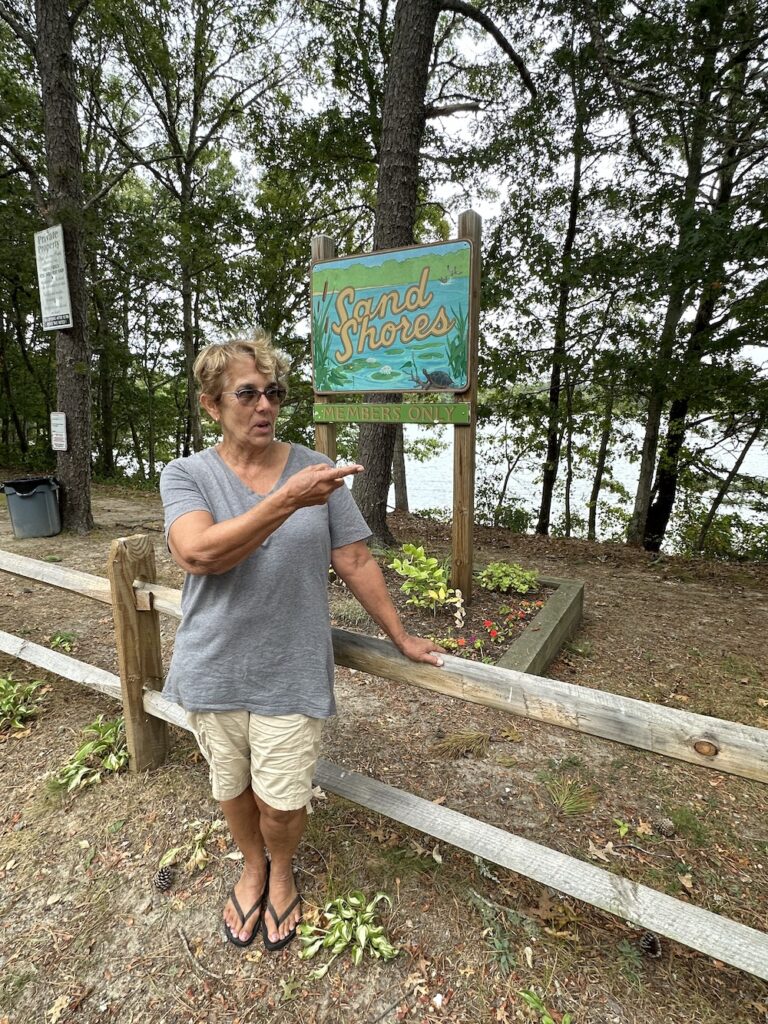
“I took water for granted,” she admitted. “I hadn’t realized how critical the water issues were—and how badly the health of the water on Cape Cod really was.”
She now sees an urgent need for more community education around fertilizer use, road runoff, and especially septic system maintenance.
“Septic systems are out of sight, out of mind. But I’m looking at the pond all the time, thinking I should probably pump mine more often.”
Pat believes a missing piece in the puzzle is a network—a way for I/A system owners across the Cape to talk, share advice, troubleshoot problems, and support each other.
“There’s no central forum for us to talk about what it’s really like—what works, what doesn’t, what needs improving.”
The hope is that these early efforts will lead to larger, town-wide strategies for wastewater management and pond protection.
“The Cape is lucky to have organizations like the Barnstable Clean Water Coalition,” Pat said. “They’re doing the hard work of getting us to think about long-term, not just short-term fixes.”
Looking out over Shubael Pond today, the water is clearer than it was a decade ago. But there’s still work to be done—and for Pat, the choice is clear:
“If you’re not part of the solution,” she said, “you’re part of the problem.”
Read more from the System Shift series here.