

July 30th is World Day Against Trafficking in Persons

This year’s campaign highlights the vital role of law enforcement and the criminal justice system in dismantling organized trafficking networks while ensuring a victim-centered approach.
What is Human Trafficking? Human Trafficking is a form of modern-day slavery. It is a criminal activity in which traffickers use force, fraud or coercion to control victims for purposes of engaging in commercial sex acts or forced labor services against their will.
Human trafficking continues to be a global threat driven by organized crime. More and more victims are being trafficked every year, across greater distances, with greater violence, for longer periods of time and for greater profit. From 2020 to 2023, there were more than 200,000 detected victims globally, which is just the tip of the iceberg. The actual number of unreported cases is believed to be significantly higher.
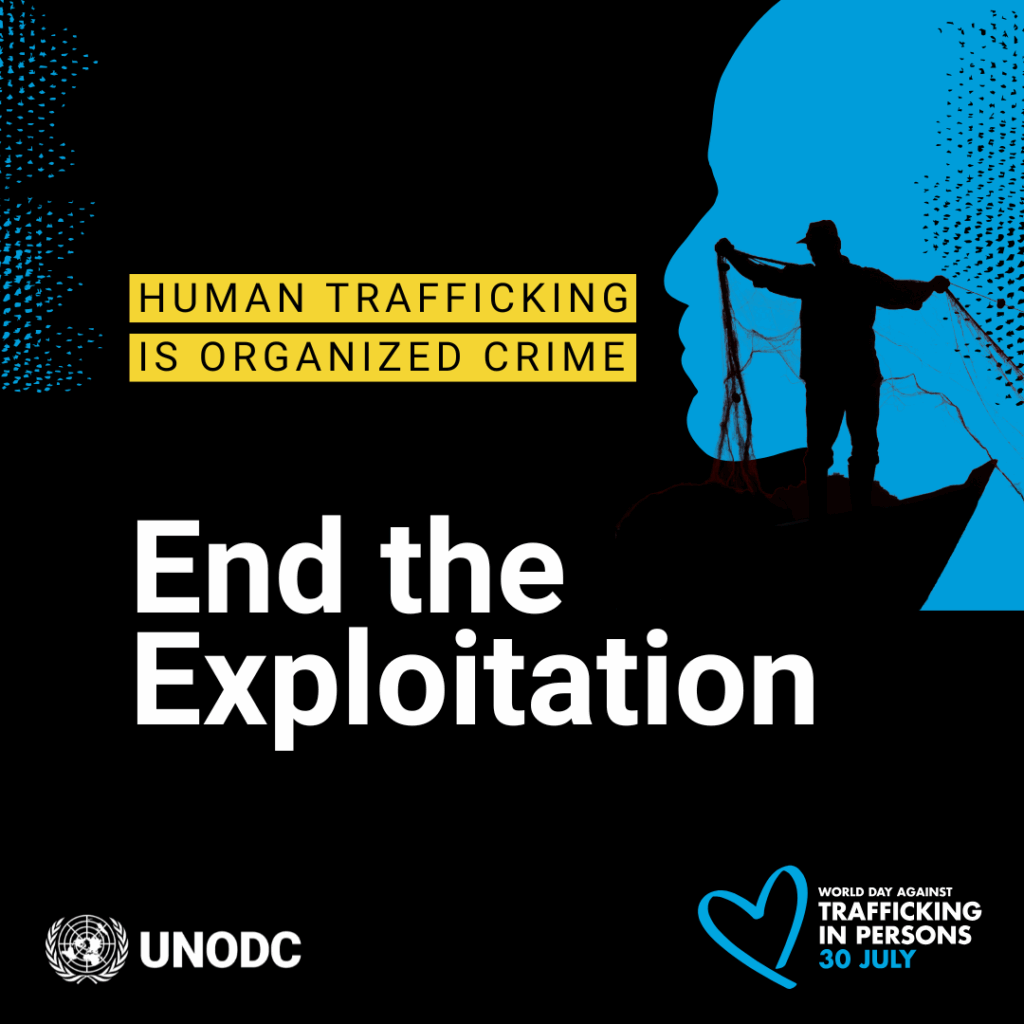
Organized criminal networks are driving this victimization and exploitation, using migration flows, global supply chains, legal and economic loopholes and digital platforms to facilitate cross-border trafficking on a massive scale. They profit from forced labor, sexual exploitation and coercion into criminal activities, such as online scams and drug smuggling.
Despite some progress, criminal justice responses fall short in tackling this rapidly evolving crime. To end human trafficking, law enforcement must enforce strict laws, conduct proactive investigations, strengthen cross-border cooperation, target criminal finances, and leverage technology to identify and dismantle trafficking networks.
Ensuring justice for survivors requires holding perpetrators accountable and providing a victim-centered approach to protection, support and access to justice.
Learn more at World Day Against Trafficking in Persons | United Nations>>> Also: World Day Against Trafficking in Persons – 30 July>>>
How to report Human Trafficking: Never try to intervene or “rescue” someone yourself. Report immediately to proper authorities. The first thing to do is report to your local police department. Reports can be made anonymously and confidentially.
Human Trafficking on the Cape and Islands
Local Human Trafficking Resources
- Human Trafficking Hotline (Accepts Calls OR Texts) 774-822-0632
- Online Submission Form (this provides option for translation to many other languages) Human Trafficking Tip Line | Cape and Islands DA, MA
- Children’s Cove
- National Center for Missing & Exploited Children
- Call 1-800-843-5678
- www.missingkids.com
- National Human Trafficking Resource Center
- Call 888-373-7888 or text “Info” or “Help” to BEFREE (233733)
- US Immigration and Customs Enforcement (ICE), Homeland Security Investigations
- ICE Hotline 866-347-2423 (U.S. and Canada)
- Immigration Tip For
- Cape Cod PATH (People Against Trafficking Humans): https://capecodpath.org