

Massachusetts Makes Alpha-gal Syndrome Reportable; Lone Star Ticks First Documented on Cape Cod in 2015
New data advances understanding of tick-related meat allergy on Cape Cod
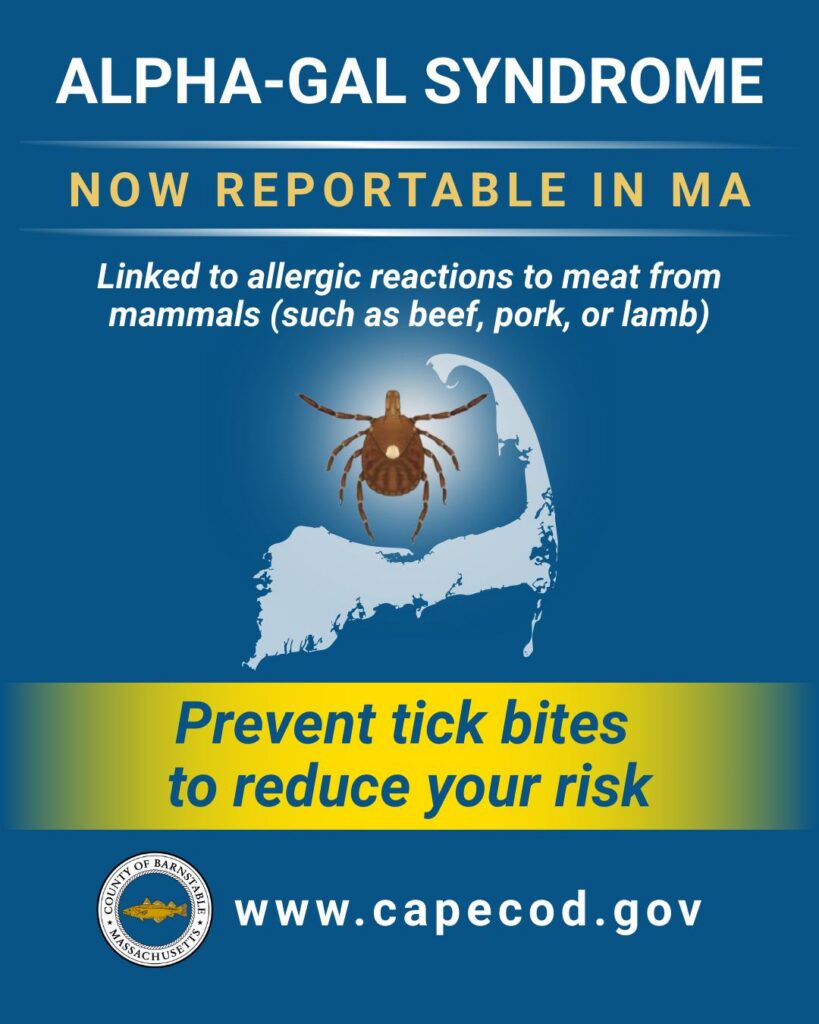
March 19, 2026 (Barnstable, MA) – Barnstable County public health officials are highlighting new guidance from the Massachusetts Department of Public Health (DPH); the DPH is designating Alpha-gal Syndrome (AGS) as a reportable condition in Massachusetts. This change will help public health agencies better track where this emerging tick-associated allergy is occurring and how it is affecting communities.
The Barnstable County Department of Health and Environment and the Cape Cod Cooperative Extension continue to work with local Boards of Health, healthcare providers, and regional partners to monitor tick activity and provide prevention guidance.
Alpha-gal Syndrome is an allergy that can develop after a bite from the lone star tick (Amblyomma americanum). Individuals with AGS may experience allergic reactions after consuming mammalian meat, such as beef, pork, lamb, venison, or rabbit. Some may also react to dairy products or medications derived from mammalian ingredients.
Unlike typical food allergies, Alpha-gal reactions are delayed, often occurring two to ten hours after eating.
Symptoms range from mild to life threatening and can include:
• Hives or itchy rash
• Stomach pain, nausea, vomiting, or diarrhea
• Swelling of the lips, tongue, or throat
• Shortness of breath or wheezing
In severe cases, reactions may lead to anaphylaxis, which requires immediate medical care.
A Growing Concern on Cape Cod
The lone star tick was first documented on Cape Cod in 2015 and has become increasingly common in parts of the region.
“Lone star ticks have become more common on Cape Cod over the past decade,” said Escher Cattle, Entomology Extension Educator with Barnstable County’s Cape Cod Cooperative Extension. “As their presence grows, awareness of Alpha-gal Syndrome is increasingly important. Preventing tick bites remains the best way to reduce risk.”
Barnstable County officials have been working closely with public health partners on Martha’s Vineyard, where Alpha-gal Syndrome has already emerged as a significant concern.
“The Martha’s Vineyard Hospital laboratory data gave us the early warning signal,” said Lea Hamner, epidemiologist with the Inter-Island Public Health Excellence Collaborative and former Barnstable County epidemiologist. “However, positive test results alone cannot confirm clinical allergy, as symptoms are the primary determining factor. Reportability allows public health to complete the picture.”
Symptoms First, Testing Second
Public health experts emphasize that Alpha-gal testing should only be conducted when symptoms are present and in consultation with a healthcare provider.
A blood test alone cannot diagnose Alpha-gal Syndrome; symptoms are the primary determining factor and must be evaluated alongside test results.
Why Reportability Matters
Designating Alpha-gal Syndrome as a reportable condition allows public health officials to move beyond simply counting positive laboratory tests.
The new reporting system will help state, county, and local health officials:
- Track confirmed Alpha-gal Syndrome cases
- Identify geographic patterns
- Monitor trends over time
- Strengthen guidance for clinicians and the public
“Tracking cases helps public health agencies better understand how Alpha-gal Syndrome is affecting communities and where prevention efforts should be focused,” said Jay Gardiner, Director, Barnstable County Department of Health and Environment.
This information supports more targeted prevention efforts, improved clinical awareness, and clearer public guidance on reducing tick exposure.
Prevention Still Matters Most
Residents and visitors are encouraged to:
- Wear permethrin-treated clothing when outdoors
- Use EPA-approved tick repellents on exposed skin
- Perform daily tick checks after spending time outside
- Remove any ticks promptly
- Shower and wash clothing after outdoor activities
Lone star ticks may be active from early spring through fall, depending on weather conditions.
For information about tick-borne illnesses and prevention, visit the Barnstable County Department of Health and Environment website:
For Cape Cod–specific tick identification and prevention resources, visit:
ABOUT BARNSTABLE COUNTY DEPARTMENT OF HEALTH AND ENVIRONMENT
Established under a Special Act of the Legislature in 1926, the Barnstable County Department of Health & Environment (BCDHE) provides regional public health and environmental health services throughout the 15 towns comprising Barnstable County. The Department manages several environmental, public health, and homeland security grants funded through state and federal resources. The Department’s primary mission is to protect public health and the environment and promote the physical and mental health and well-being of Barnstable County residents.
ABOUT CAPE COD COOPERATIVE EXTENSION
Cape Cod Cooperative Extension is the education department for Barnstable County. Educational programs focus on agriculture, marine resources, horticulture, aquaculture, natural resources, water quality, recycling, household hazardous waste, nutrition, food safety, youth development and environmental education issues facing the county. Extension programs are conducted in Barnstable County in cooperation with the staff at the University of Massachusetts, and The Woods Hole Oceanographic Institution–Sea Grant program. www.capecodextension.org
###